
Some words stop you mid-thought. Axiom is one of them. You’ve probably seen it in a math textbook or a philosophy class and wondered what it actually means. Well, the axiom meaning is simpler than it sounds — and way more useful than most people realize.
Fundamentally, to define an axiom is to describe a truth so obvious it needs no proof. It’s just accepted. Think of it as the foundation beneath an argument — the part everyone agrees on before the real thinking even begins. That’s the axiom definition in its purest form.
So what is an axiom, really? It’s a starting point—a bedrock principle. Whether you’re solving a geometry problem or making a life decision, axioms are quietly doing the heavy lifting. Stick around — by the end, this word will make complete sense.
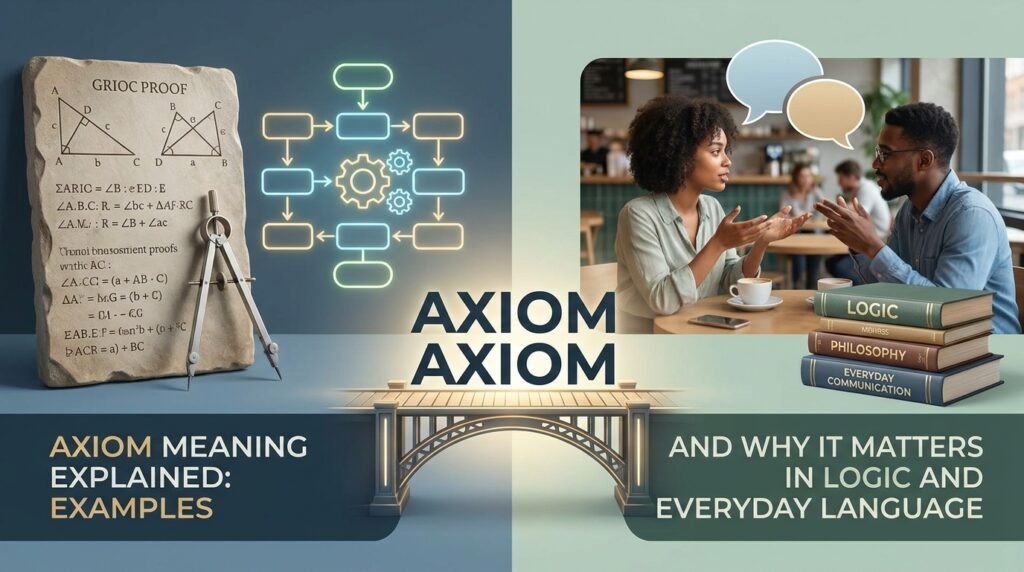
Axiom
Some words carry more weight than they appear to. Axiom is one of them. At its core, an axiom is a statement so fundamentally true that it doesn’t need proof — it’s simply accepted as the starting point for deeper reasoning. Think of it as the ground floor of an argument. Everything else gets built on top of it.
You’ll find axioms showing up across mathematics, philosophy, science, and even casual conversation. When someone says “you get what you put in,” that’s functioning as an axiom — a foundational belief people accept without demanding evidence. It shapes how they think and act from that point forward.
Part of Speech
An axiom is a noun. It’s pronounced ak-see-uhm, and its plural form is simply axioms. You’d use it to name a specific principle or self-evident truth — not as a verb or descriptor.
Here’s a quick breakdown:
- Word: Axiom
- Type: Noun
- Pronunciation: ˈak-sē-əm
- Plural: Axioms
- Related forms: Axiomatic (adjective), Axiomatically (adverb)
Did You Know?
Here’s something worth pausing on. In logic and mathematics, an axiom isn’t just a popular opinion — it’s an unprovable rule accepted as true because it’s either completely self-evident or practically useful as a foundation. For example, the idea that “a thing cannot both exist and not exist at the same time” is a classic axiom of logic. Nobody proves it. Everyone just agrees it holds.
People often mix up axiom and postulate, and honestly, the two are closely related. However, a postulate tends to appear more often in mathematical contexts — such as Euclid’s postulates in geometry — whereas an axiom has a broader philosophical reach. And neither one is a theorem. A theorem actually requires a formal proof built from those axioms. That’s a key distinction worth remembering.
Axiom Used in a Sentence
Seeing a word in action makes it stick. Here are a few natural examples of an axiom used correctly:
- “The entire argument rests on a single axiom — that people act in their own interest.”
- “In geometry class, we started with Euclid’s axioms before solving any proofs.”
- “She lived by the old axiom: honesty is the best policy.”
- “Scientists treat certain principles as axioms, even when direct proof isn’t possible.”
- “The axiom that ‘time is money’ shapes how most businesses operate.”
Notice how the word works in different settings — from formal logic to everyday wisdom. That flexibility is part of what makes axiom such a useful term.
Word History and Origins
The word “axiom” has traveled a long road to reach modern English. It first appeared in English in the 15th century, borrowed from Middle French axiome, which in turn came from Latin axiōma. But the real root sits in ancient Greek — axíōma, meaning something considered worthy of acceptance or honor.
That Greek origin connects to the verb axioûn, meaning “to consider worthy” or “to think appropriate.” So at its etymological heart, an axiom is something deemed worthy of being believed — not forced on you, but earned through its own obvious weight. That’s a pretty elegant concept when you think about it.
Common Phrases That Contain Axiom
One well-known phrase you’ll encounter is the axiom of choice — a specific principle in set theory and higher mathematics. It states that given any collection of non-empty sets, you can always pick one element from each. Simple to state, surprisingly controversial in mathematical circles.
Beyond formal math, the word axiom pops up in phrases like:
- “By axiom” — meaning something is true by accepted principle, not by proof
- “Axiomatic truth” — a truth so obvious it needs no argument
- “Treat as axiomatic” — to accept something as a given starting point
These phrases appear in academic writing, philosophy texts, and even business strategy discussions.
Explore Related Words
If you’re building your vocabulary around axiom, these related terms are worth knowing:
- Postulate — a foundational assumption, especially in geometry
- Theorem — a proven statement derived from axioms
- Maxim — universally accepted truths
- Premise — an assumption used as the basis for an argument
- Tenet — a core belief or principle held by a group
- Aphorism — a short, clever statement expressing a general truth
- Dictum — a formal or authoritative statement
Each of these overlaps with axiom in some way, but they’re not interchangeable. Knowing the difference makes your reasoning — and your writing — sharper.
How to Cite This Entry
If you’re referencing the word axiom in academic work, here’s how you’d generally format a dictionary citation depending on your style guide:
MLA: “Axiom.” Dictionary, Publisher Name, URL. Accessed Day Month Year.
APA: Axiom. (n.d.). In Dictionary name online. Retrieved from URL
Chicago: “Axiom.” Dictionary Name. Accessed June 5, 2026. URL.
Always double-check the specific format your institution or publication requires, since style guides update periodically.
Axiom — Simplified for Kids
Let’s make this simple. An axiom is a rule that everyone agrees is true — even without proof. It’s like saying “the sky is above us.” You don’t need a science experiment to confirm it. You just know it’s true, and you use that fact to figure out other things.
In math class, teachers use axioms all the time. For example, “if two things are both equal to a third thing, they’re equal to each other.” That’s an axiom. No one proves it — it’s just the rule everyone starts with.
More on Axiom from Trusted Sources
If you want to go deeper on this word and concept, several reliable sources cover it well. Dictionaries like Merriam-Webster and Oxford give solid linguistic definitions. For the philosophical side, Stanford Encyclopedia of Philosophy offers thorough, readable entries. And if you’re interested in how axioms function in math, Khan Academy and Britannica both break it down in an accessible way.
Exploring multiple sources helps, especially because an axiom means slightly different things depending on whether you’re in a math class, a philosophy seminar, or just a regular conversation.
What Makes a Statement an Axiom? Understanding the Core Idea
Not every obvious-sounding statement qualifies as a true axiom. A real axiom has to meet a few specific standards. First, it must be self-evident — meaning any rational person, when they genuinely think it through, would accept it as true. Second, it can’t be derived from something more basic. If you can prove it using other statements, it’s a theorem, not an axiom.
Think of it this way. Axioms are like the rules of a board game. You don’t question them mid-game — you accept them and play. Without those foundational rules, nothing else in the game makes sense. The same logic applies in mathematics and philosophy. Strip away the axioms, and the entire logical system collapses.
Axiom in Mathematics, Philosophy, and Real Life — Key Differences
The word axiom means something slightly different depending on where you use it, and that’s worth clarifying.
In mathematics, axioms are precise, formal statements that form the foundation of an entire system. Euclid’s five postulates, for instance, underpin classical geometry. Every theorem in that system traces back to those starting points.
In philosophy, axioms are broader. They’re self-evident truths used to build logical arguments. Descartes’ “I think, therefore I am” functions like a philosophical axiom — an undeniable starting point from which other conclusions follow.
In everyday life, people use axioms more loosely. Sayings like “treat others how you want to be treated” act as personal axioms — guiding principles accepted without question. They shape decisions without anyone demanding proof.
How Axioms Differ from Theories, Hypotheses, and Assumptions
This is where a lot of people get confused, so let’s clear it up.
- An axiom is accepted as true without proof — it’s the starting line.
- A hypothesis is an educated guess that still needs testing.
- A theory is a strong explanation backed by substantial evidence.
- An assumption is something you believe for the sake of an argument, but it could turn out to be wrong.
The biggest difference? Axioms aren’t up for debate within their system. Assumptions are. A theory can be revised. A hypothesis can fail. But in formal logic or math, you don’t challenge an axiom — you build on it.
Why Axioms Still Matter in Modern Thinking and Everyday Reasoning
You might think axioms belong only in dusty philosophy textbooks. They don’t. Every time you reason through a problem — whether it’s a business decision, a moral question, or a scientific argument — you’re resting on foundational assumptions. Those assumptions are your axioms.
In the age of information overload, being clear about your axioms actually matters more than ever. When two people argue and can’t agree, it’s often because they’re starting from different axioms. One person assumes humans are fundamentally cooperative. Another assumes they’re fundamentally self-interested. Neither can convince the other because they’re not even starting from the same ground.
Famous Axioms in History That Shaped Human Knowledge
Some axioms didn’t just influence a single argument — they reshaped entire fields of human thought. A few standouts:
- Euclid’s Parallel Postulate — foundational to geometry for over 2,000 years
- “The whole is greater than the part” — a logical principle dating back to ancient Greece
- Newton’s laws as axiomatic principles — treated as self-evident truths in classical physics for centuries
- “All men are created equal” — used as an axiomatic claim in political philosophy and the U.S. Declaration of Independence.
- Peano Axioms — the formal foundation of arithmetic developed in the 19th century
Each of these started as an accepted truth and went on to anchor entire systems of knowledge.
How to Use the Word “Axiom” Correctly in Writing and Speech
Using axiom well comes down to context. In formal writing — academic papers, logical arguments, philosophical essays — use it precisely to mean a self-evident foundational principle. Don’t use it as a fancy word for “opinion.”
In casual writing or speech, it’s fine to use axiom to refer to a widely accepted truth or guiding principle. Just make sure the statement you’re calling an axiom is actually something broadly agreed upon — not just your personal belief.
A quick tip: if you’re unsure whether something qualifies as an axiom, ask yourself — would most reasonable people accept this without needing proof? If so, you can probably call it an axiom. If it needs convincing, it’s more of a claim or an argument.
Conclusion
So now you’ve got a solid grip on axiom meaning — what it is, where it came from, and how it actually works in the real world. It’s not just a vocabulary word. It’s a concept that quietly shapes logic, math, philosophy, and even everyday decisions.
To define axiom simply: it’s a self-evident truth accepted as a starting point—no proof required. Whether you’re studying geometry, building an argument, or just thinking through a tough decision, axioms are always somewhere in the background, holding things together.
Understanding what an axiom is gives you a sharper way to think. When you know your foundational beliefs, you reason better. The axiom definition might feel abstract at first, but once it clicks, you start seeing these foundational truths everywhere. And that’s honestly pretty useful — in school, in work, and in life.
Axiom Meaning Axiom Meaning Axiom Meaning Axiom Meaning Axiom Meaning Axiom Meaning Axiom Meaning Axiom Meaning Axiom Meaning Axiom Meaning Axiom Meaning Axiom Meaning Axiom Meaning Axiom Meaning Axiom Meaning Axiom Meaning Axiom Meaning Axiom Meaning Axiom Meaning Axiom Meaning Axiom Meaning Axiom Meaning Axiom Meaning Axiom Meaning Axiom Meaning Axiom Meaning Axiom Meaning Axiom Meaning Axiom Meaning Axiom Meaning Axiom Meaning Axiom Meaning Axiom Meaning Axiom Meaning Axiom Meaning Axiom Meaning Axiom Meaning Axiom Meaning